Andrew Trask — @iamtrask, one of the more credible voices in AI research — responded to the OpenRouter Fusion announcement with this: "Frontier AI companies will never own the frontier again. I kid you not... I've been waiting for someone to show this result for like 4 years."
Four years. That's not a hot take. That's someone who understood something structurally true long before there was a benchmark to prove it.
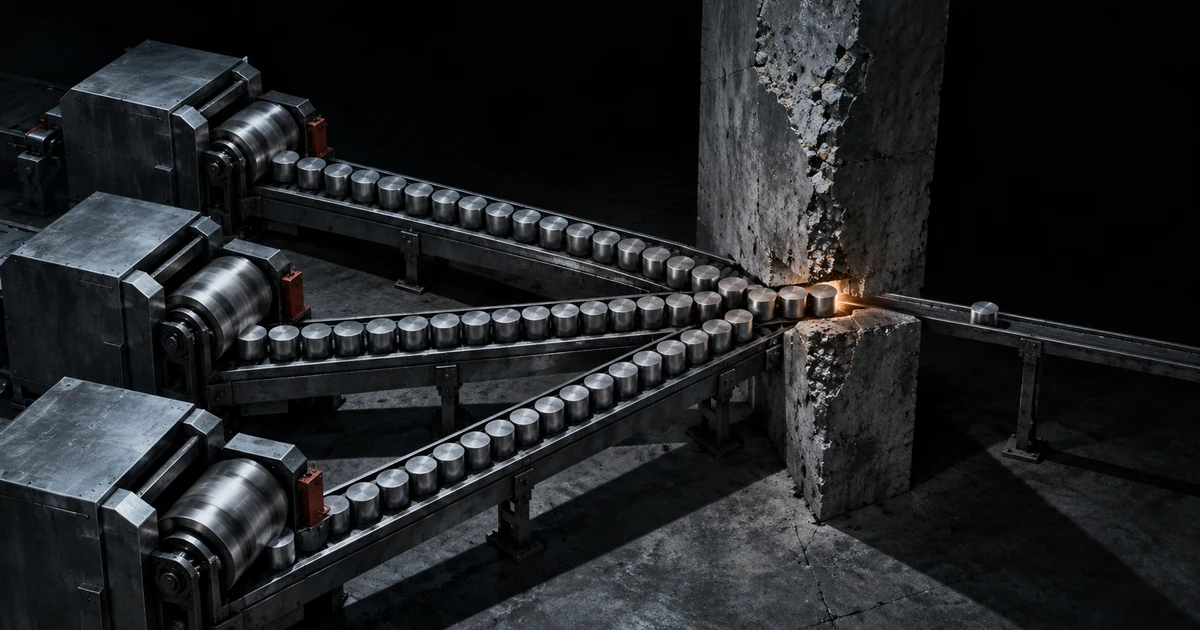
Here's what changed. OpenRouter shipped openrouter/fusion: you send one prompt, it fans out to a panel of models in parallel, a judge synthesizes the outputs, you get a final answer. Simple concept. The results are not.
The number that matters isn't the headline. It's this: Claude Opus 4.8, fused with itself twice — same model, same weights, no new training — scores 65.5%. Solo, it scores 58.8%. That's 6.7 points from literally running the same model twice and having a judge reconcile the outputs. No new data. No retraining. Just composition.
If you can extract 6.7 points from redundancy, imagine what genuinely diverse models with different failure modes produce. The top result of 69.0% starts looking like a floor.
This is Trask's point. Scaling laws don't care what the substrate is. For a decade it was model size — more parameters, more compute, better results. That worked. But scaling laws are agnostic. They describe how intelligence grows with resources. Composition is a resource. And it scales in a space that doesn't cost $500M to enter.
The budget panel makes this embarrassingly concrete: Gemini Flash + Kimi K2.6 + DeepSeek V4 Pro fused at 64.7% — beating GPT-5.5 and Opus 4.8 solo — at half the cost of Fable 5. You don't need the frontier model. You need a good synthesis architecture.
My take: none of this is surprising if you've been building persistent agentic workflows. When I published the APEX Framework in April, the judge/generator separation was already a core architectural requirement — not a novelty. The generator can't grade its own homework. Self-evaluation is a known failure mode. A structurally separate judge is how you fix it. The benchmark is new. The pattern isn't.
And as I described in the /goal inner loop piece from May, the real compound effect comes from persistence — agents that carry context across cycles, systems that get better at synthesizing because they accumulate evidence about where things go wrong. A benchmark result is a snapshot. Durable architecture is the actual story.
The moat isn't the model anymore. It's the workflow.
The question from here: not which model is best, but how to design a reasoning architecture that improves as it runs. Trask waited four years for data to back that up. Now it's there.