You have seen it. Maybe today. An email that reads like the last three. A LinkedIn post using the same phrasing as the one above it. A pitch deck where every slide says "moat" and "delve."
Something feels off. Not wrong. Just same.
I think about this a lot. Not as a technical problem. As a cultural one.
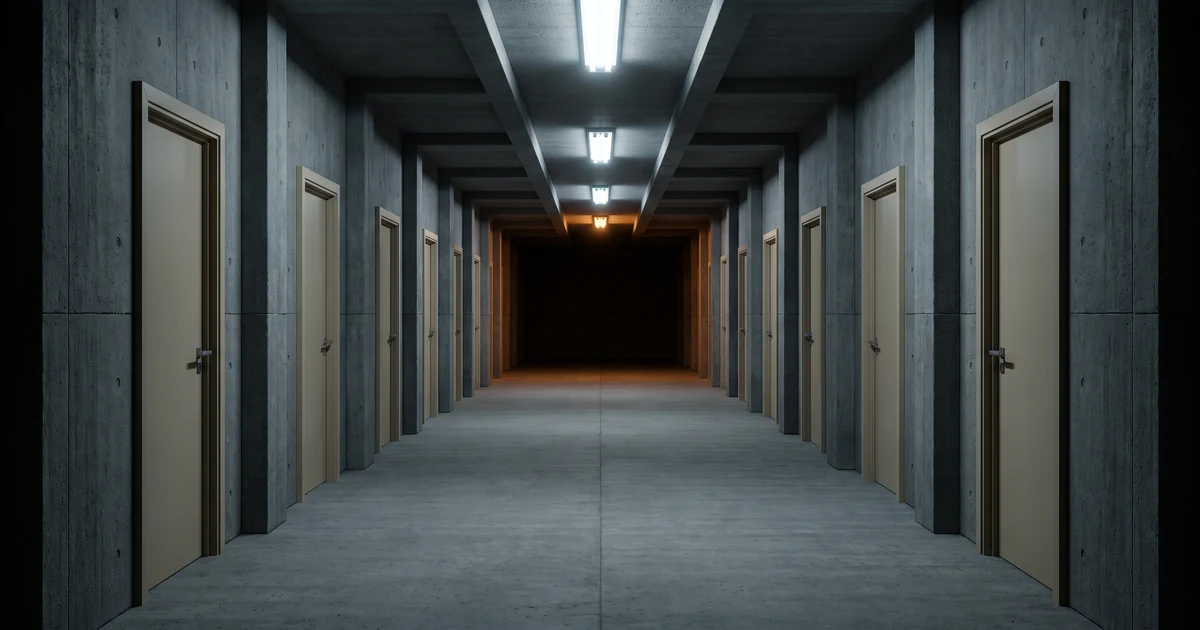
Researchers linked a text-to-image model to an image-to-text model and let them talk in a loop. Image, caption, image, caption. No human intervention. Within a handful of iterations, every starting prompt collapsed into the same output. They tried a prime minister wrestling with war strategy. After a few loops, it became an empty room with nice curtains.
The study, by Arend Hintze, Frida Proschinger Åström, and Jory Schossau (published January 2026 in Patterns), measured how quickly outputs became visually and semantically indistinguishable. They tried adding randomness to break the drift. It didn't work.
Left alone, generative models do not wander. They settle. Randomness does not break the pull toward the average.
The mathematics of sameness
Here is what is happening mechanically.
Every time you convert meaning from one format to another — an image into a description, a description back into an image — something gets lost. High-dimensional meaning squeezed into a smaller container and back. What survives is whatever sits closest to the center of what the model has seen before.
Do that a hundred times and you do not drift. You lock in. That is what the study measured: 700 trajectories, every starting prompt collapsing into the same visual motifs by around the hundredth iteration. Not a gradual fade. A lock-in.
I call this the mathematics of sameness. It is not a bug in any particular model. It is what happens to any pipeline that converts meaning between formats without a human injecting new signal at some point along the way. And modern culture runs on these pipelines now. Images become alt text, then images again. Articles get summarized and regenerated. More than half of new articles on the web are already AI-written, according to a 2025 Graphite study.
Every translation between formats loses what is unfamiliar. Loop the translation and only the generic survives. That is the mechanism behind the elevator music.
From mainstream to Me-Verse
Here is where I think this gets culturally uncomfortable. Because we have been here before.
One flavor for everyone
Up until around 2005 we lived in the Mainstream Era. Three networks. Top 40. Blockbusters that everyone saw whether they wanted to or not. Culture was a shared town square, and the price of admission was sameness.
This was broadcast scarcity. There was not enough bandwidth for everyone to have their own channel. So we all shared one.
A million channels, all averaging out
Then the smartphone shattered it. Not the web — the web was still a shared place, a desktop in the family room. The smartphone moved culture into everyone's pocket, tuned to their own taste, refreshed every second.
We entered the feed bubble era. Millions of niches, each with its own local celebrities, its own language, its own rhythm. The sameness did not disappear. It fractured. And here is the key thing about algorithmic selection: the feeds were not neutral. The algorithm selected whatever kept you engaged longest. Sameness emerged from the bottom up, from your own behavior, curated to a local average. Every bubble eventually hit the same ceiling of repetition — because engagement optimization converges, just like everything else.
The average, manufactured at source
Now AI introduces something structurally different: generated convergence.
Think of it this way. In the Mainstream Era, sameness was a broadcast tower. One signal, everyone received it. You could build a new tower — the internet did exactly that.
In the feed bubble era, sameness was a mirror. Millions of small mirrors, each reflecting back what you already liked. You could switch mirrors — change platforms, follow different accounts.
Now sameness is baked into the recipe itself. The AI does not wait to see what you engage with. It produces the average from the start, inside the pipeline, before anything reaches a feed or a curator. The sameness is not selected after the fact. It is manufactured at the moment of creation.
This is not the Me-Verse. Not yet.
The Me-Verse — the hyper-personalized reality engineered for a target group of one — is still ahead of us. When it arrives, it will not feel like sameness at all. It will feel like the opposite: every feed, every interface, every piece of content tuned to an audience of one. But that is not where we are today.
Today we are in the in-between. We have the production power of AI without the maturity to use it for personalization. So we do the only thing we know how to do: we produce. The volume of AI-generated content on the web is already several times larger than what humans alone were producing two years ago. Every bubble flooded with more of itself. An order of magnitude more of a bubble is not an order of magnitude more meaning. It is the same average, amplified.
The slop we are starting to see is not a model problem. It is a maturity problem. Production-efficiency mode is the problem — we are optimizing for volume because volume is the only lever we have learned to pull. The Me-Verse promises hyper-personalization. What we have instead is hyper-production, and it tastes like sameness.
Culture has cycled through eras of sameness. The Me-Verse promises personalization. What we have is hyper-production.
We are in the in-between: we have AI production power but not AI maturity. The Me-Verse promises hyper-personalization, but what we have instead is hyper-production, and it tastes like sameness. The organizations that learn to differentiate through meaning and intent are the ones that will cut through.
What survives the average
The study tested one main model pair. A cross-combinatorial experiment across others confirmed the same convergence held. We do not yet know if text-only pipelines behave differently, or whether human review at scale can prevent the drift without something structural changing first. I do not have that evidence. Neither does anyone else yet.
What we do have is a mechanism — a convergence effect that randomness could not break — already running inside pipelines in every organization.
I think one thing is becoming clear: the organizations that cut through this will not be the ones producing the most. They will be the ones who figured out that differentiation is set at the intent-injection points, and those points are earlier than most people think.
One path scales and one does not. More humans at every review stage is the right instinct, but it does not survive contact with a large organization. What scales is capturing intent upstream — in the briefs and context that feed the systems — so the output carries a point of view instead of a statistical average.
That is the difference between adding friction and adding meaning.
When function is free and everything converges, what survives is what was actually meant. Differentiation is not a luxury for later. It is a discipline for today, running parallel to production from the very first decision.
When everything can be generated at scale, what survives is what was actually meant. Differentiation is not a luxury for later. It is a discipline for today, running parallel to production from the very first decision.
(The broader framework, from the Me-Verse to why meaning becomes the only remaining axis of competition, is in my book The Digital Singularity Shift.)