McKinsey surveyed 500 senior marketing leaders across Europe — France, Germany, Italy, Spain, the UK — and asked them what matters most.
Branding ranked #1. Authenticity ranked #4. Employer branding #5. Cultural relevance and trendiness saw the sharpest year-on-year rise of any category. 72% plan to increase marketing budgets in the next 12 months.
And buried a few pages in: only 6% of European CMOs are mature in generative AI. Those 6% are reporting 22% efficiency gains. The 89% who haven't invested report zero.
That's the State of Marketing Europe 2026 in three data points. The story those three points tell together is more significant than any of them in isolation — and this trend will only accelerate as AI capability compounds and the gap between the leaders and the rest widens.
The urgency underneath the branding signal
The easy read: brand still matters, AI is overrated, stay the course.
I think that reading is dangerous.
In my work as a Tech Director within AI, advising large brands on digital transformation, I've seen the same pattern too many times: brand is treated as an afterthought. Something the comms team handles after the real decisions have been made. And when organizations do invest in brand narrative, they default to the path of least resistance — sustainability as the canonical story. Not because it's distinctive or meaningful to their specific audience, but because it's safe. It's consensus. It says nothing that a competitor couldn't say identically.
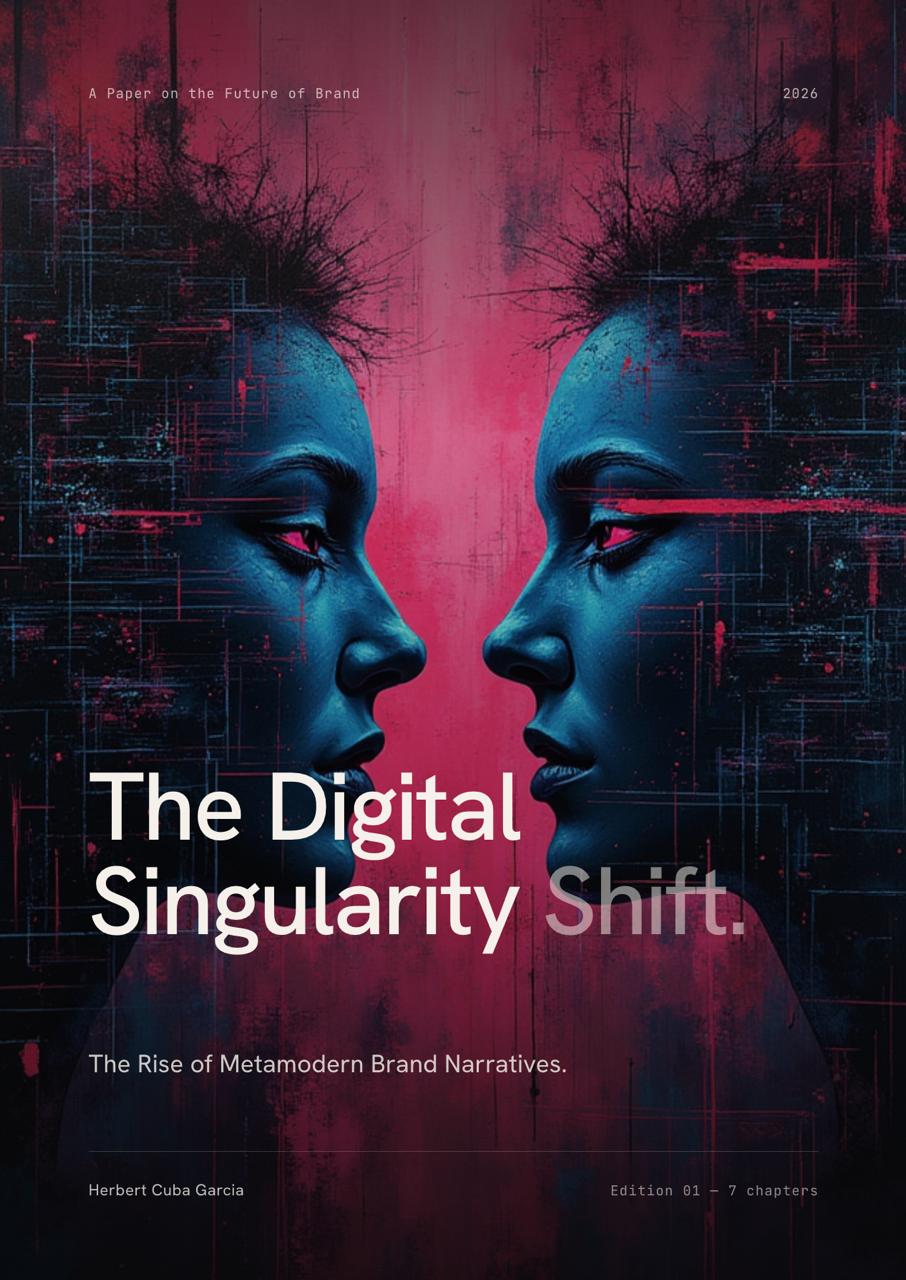
I saw this pendulum reaching its end. In my book The Digital Singularity Shift, I outlined what happens when that pendulum swings back — when organizations are forced to find something genuinely their own to stand for, or get drowned out by a market where AI can produce generic messaging infinitely and for free.
The McKinsey data suggests the swing is now underway.
Brand isn't rising because it was always important and people are finally noticing. It's rising because something is forcing organizations toward a different kind of relevance — social, cultural, meaning-building relevance — at speed. The CMOs feeling this urgency are right to act on it. Most of them just haven't named what's creating the pressure.
McKinsey names it directly, even if they don't frame it this way: "The role of brands is shifting from providing functional benefits to fostering emotional relevance and trust. While algorithms take over tasks like product comparison and efficiency, emotional attachment and authenticity will become the primary drivers of brand value."
That's the mechanism. When AI compresses functional excellence toward commodity — when "better" becomes baseline, available to any competitor with API access — functional differentiation stops being a moat. The competition moves up the value stack. Emotional resonance. Cultural position. Social relevance. Meaning.
The organizations that understand this are treating brand as Strategic Infrastructure, not a comms function. That's the shift in the data. Four of McKinsey's top five CMO priorities point away from short-term activation and toward long-term brand and trust building. This is not a soft preference. It's a structural response to a structural change in competitive dynamics.
The AI filter is already running
The 89% number needs to be understood clearly.
89% of European CMOs have materialized zero efficiency gains from generative AI. McKinsey calls AI's ranking at #17 out of 20 "a serious undervaluation." The leaders — the 6% — place AI in their top five priorities and reinvest the efficiency gains directly into growth.
The gap is not about the technology. The technology is available to everyone. The gap is about organizational decision-making. The 6% made a commitment earlier. That commitment is now compounding into a structural cost advantage that their competitors are running out of time to close.
Kraft Heinz didn't upgrade a tool. They compressed creative workflows from 8 weeks to 8 hours. Coca-Cola's agentic AI delivered personalized coupons to 800,000 consumers and drove 4x higher click-through rates — not because the AI was clever, but because the organization had built the capacity to deploy it at scale against a clear brand objective.
The 89% are not behind because they're incapable. They're behind because their organizations weren't architected to make this kind of transformation possible.
That's the actual problem. And it connects directly to why brand is rising at the same time AI investment is lagging.
What re-architecting actually means
38% of European companies don't have a dedicated marketing leader in the C-suite. Let that sit for a moment.
In an environment where McKinsey's data shows branding as the #1 competitive priority and cultural relevance as the fastest-rising imperative, more than a third of European companies don't have a senior executive accountable for it at the board level.
That's not a communications gap. That's an organizational architecture gap.
Re-architecting for Cultural Relevance isn't a brand refresh or a new campaign strategy. It's four structural shifts that have to happen at the organizational level.
Shift 1 — From Broadcast to Participation. The data on interactive branding is unambiguous. Raw and unpolished campaigns, anti-advertising aesthetics, user-generated content — all rising sharply. The average consumer is exposed to 4,000 to 10,000 ads per day. Click-through rates have dropped over 40% from fatigue alone. The organizations winning cultural ground right now are not broadcasting louder. They're building spaces where their communities make the brand together.
Doritos didn't spend their way to 3 billion impressions. They built a Triangle Tracker — an absurdist tool that let people scan chip shapes in the wild — and got 4 million scans from people who wanted to participate in something genuinely strange. Louis Vuitton's Pharrell Williams cultural shows generated 775 million views. Not from media spend. From genuine cultural stakes.
Shift 2 — From Feature Wars to Meaning Wars. Bottega Veneta's "Craft is our Language" campaign is not about product features. It's a statement of value — craft over celebrity, permanence over trend. It works because the brand has an actual point of view. A real aesthetic commitment. Something you cannot copy by iterating faster.
Shift 3 — From Cost Center to Cultural Infrastructure. The CMOs planning to increase budgets — 72%, versus 49% who actually did last year — are not doing so because marketing got easier. They're doing it because in a world where AI commoditizes execution, the brand's cultural position becomes the primary moat. Creativity and uniqueness ranked as the top investment area for the next two years. Not efficiency. Not automation. Creativity.
Shift 4 — From Safe to Sincere. 81% of Gen Z abandon brands that feel inauthentic (Adobe, 2023). But what Gen Z reads as inauthentic isn't rough production values. It's the gap between what a brand claims to stand for and what it actually does. The absence of a real position. Brands that take no creative risks because they're optimizing to offend no one.
The organizations making this shift hold both simultaneously: a genuine mission they won't apologize for, and a cultural fluency in how they present it. That's the Metamodernist positioning — sincerity about what you are, irony about the performance of it. The wink tells the audience you know they know it's marketing. The sincere mission tells them it matters anyway.
B2B brands are adopting B2C formats — storytelling, community-building, cultural participation — at 20 percentage points faster than the average. Even sectors that had no cultural-relevance vocabulary two years ago are building it now. The data is telling them they have no choice.
The results are already visible
This is not theoretical. The organizations that started this journey are already showing results.
Kraft Heinz compressed 8 weeks to 8 hours. Coca-Cola's agentic AI drove 4x CTR on personalized outreach to 800,000 people. Louis Vuitton built a cultural moment that generated 775 million views without traditional media buying. Doritos made a chip shape into a 3-billion-impression cultural event.
The 6% with mature AI use it to reinvest — they take efficiency gains and direct them toward brand, creativity, cultural position. They're not using AI to cut costs and bank the difference. They're using it to free up human energy for what AI cannot do: take a genuine cultural position, carry a real point of view, build something people actually believe in.
The Machine handles the operational layer. The Human reclaims the cultural position.
The companies not yet on this path are not running out of time in the abstract. They're running out of time in specific, measurable ways — compounding cost structure disadvantages, declining CTR from commoditized creative approaches, and a brand that's getting louder in a world that's getting better at tuning it out.
The harder question
The data is clear on what needs to happen. Build cultural relevance. Invest in brand as strategic infrastructure. Deploy AI capability at the operational layer and reinvest the gains. Hold both simultaneously.
The harder question is how organizations actually make that shift when their structures, incentives, and cultures were built for a different competitive era.
Most organizations aren't structured for cultural participation. They're structured for broadcast. Their measurement frameworks reward activation, not meaning-building. Their incentive systems punish the kind of creative risk-taking that produces genuine cultural moments. And their C-suite doesn't have a seat for the person accountable for the thing McKinsey just named as the #1 priority.
The gap between the data and the organizational reality is where companies stall. And it's the gap that determines which side of the 6%/89% divide a company lands on.
The re-architecture isn't a strategy question. It's a will question. The organizations that make it through are the ones that decide — at the structural level, not the campaign level — that meaning-building is their primary competitive work.
Three questions worth asking in your next leadership meeting:
- Does your C-suite have someone accountable for cultural relevance — not just communications?
- Are your AI efficiency gains being reinvested into brand and creative capability — or just banked as margin?
- Is your brand built for participation, or are you still broadcasting and hoping volume compensates for relevance?
If the answers are uncomfortable, the McKinsey data suggests you're not alone. But it also suggests the window to act is narrowing faster than most realize.
I wrote The Digital Singularity Shift to give organizations a working framework for exactly this transition — the sequence, the organizational logic, and the tools to make it operational: The Digital Singularity Shift — Herbert Cuba Garcia