72% of leaders see no measurable AI ROI — because the gains are real but trapped in individuals, not absorbed by the organization. We've been playing single-player: one talented person becomes a one-man army, output soars, but org-level numbers (team KPIs, DORA metrics) don't move. The fix isn't more agents or automation — it's better coordination: humans and agents cast into clear roles so their work compounds instead of competing. That's an operating-model question, not a technology one — the shift from single-player to multiplayer mode is what finally moves the organizational numbers.
72% of business leaders say their AI investments have not yet produced measurable ROI. That's not a fringe number — that's KPMG, surveying senior executives across industries. Gartner found that 49% of CIOs say AI has failed to deliver the returns they expected from 2023–2024 investments. McKinsey puts the share of organizations with genuine, bottom-line AI impact at around 5%.
The ROI that isn't showing up
The narrative doesn't match the reality. And I think I know why.
We've Been Playing Single-Player
The default mode is one talented individual becoming a one-man army — hugely productive personally, while the organization's numbers stay flat.
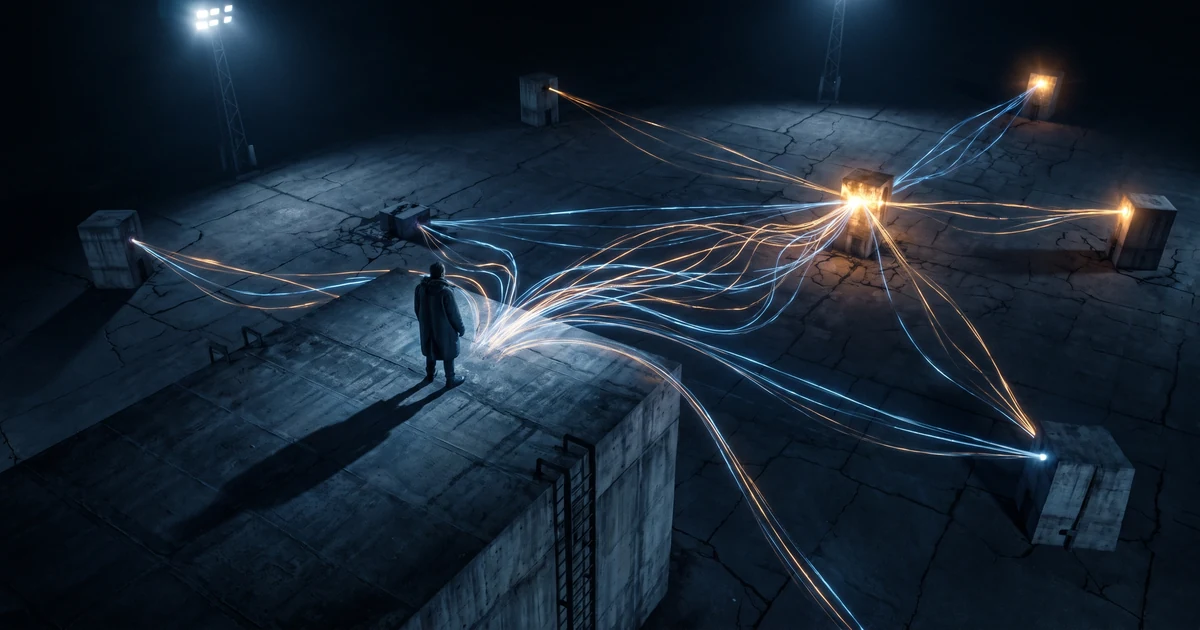
We've been treating AI acceleration as a single-player game.
What you see in practice: a talented individual — usually technical, usually curious, usually slightly obsessed — builds out a set of agentic systems. They configure the tools, write the prompts, manage the context, wire up the workflows. They become the connective tissue between the AI and everything that actually needs to get done. A one-man army.
This person is impressive. Their output goes up significantly. They move fast. They start to feel like a small team unto themselves.
But the organization's numbers don't move.
The Gains Are Real — but Trapped
Individual AI gains are measurable and large, but they pool at the edge — in the person and their private setup — and never propagate to team-level KPIs.
There's a pattern in the data. BCG found that individual consultants using AI outperformed their peers by 25% on speed and 40% on quality. But those gains didn't propagate to team-level business KPIs. The DX Institute found the same thing in engineering: developer-level productivity metrics improved 15–45% with AI tools, but DORA metrics — the ones that actually measure software delivery at the organizational level — showed no statistically significant improvement.
The gains are real. They're just trapped.
They pool at the edge — in the individual, in the isolated workflow, in the clever personal setup that only the person who built it understands. The organization doesn't absorb them. It can't. Because the individual accelerated without the organization changing around them.
The Central Misdiagnosis
The assumption that enough fast individuals will pull the org forward is wrong — you just get high performers on incompatible setups, producing output without the challenge and verification that make it the right output.
I think this is the central misdiagnosis of AI transformation right now.
The assumption is that if enough individuals accelerate, the organization will naturally follow. That's not how transformation works. What you get instead is a collection of high-performing individuals running on incompatible setups, without shared context, without coordination mechanisms, without the structured friction that comes from a team of actual experts disagreeing productively about the right approach.
The one-man army produces output. It doesn't always produce the right output. Because it lacks the thing that expert collaboration gives you: challenge, verification, and the accumulated judgment of people who've seen this problem before.
From Individual Acceleration to Coordination
The unlock isn't more agents or automation — it's better coordination between human expertise and agent execution, with agents built to live inside a team rather than boost one person.
The shift I think we're about to see — and the one I think will finally unlock the numbers that haven't moved — is from individual acceleration to human-agent collaboration at scale.
Anthropic signaled exactly this with the launch of Claude Tag in June 2026. The idea is simple: you @-tag Claude in a team channel like you would a colleague. It picks up the task, works autonomously for hours or days, and stays scoped to its role — the engineering Claude doesn't bleed into the sales Claude. It's not a personal productivity tool. It's designed to live inside a team. That's a meaningful architectural choice, and it points in the same direction I've been thinking about.
Not more agents. Not more automation. Better coordination between human expertise and agent execution.
Ocean's Eleven
Danny Ocean doesn't rob the Bellagio by being the smartest guy in the room. He wins by casting roles — the pickpocket, the explosives guy, the inside man, the acrobat — and coordinating them so each does the one thing they're best at, at exactly the right moment. A single genius, however brilliant, never cracks that vault.
That's the whole argument. The one-man army is Danny trying to do the whole heist alone. Multiplayer mode is the crew — humans and agents cast into clear roles, their work timed to compound instead of collide.
The question isn't "how do we get AI to do more?" It's "how do we organize a team where humans and agents each do what they're actually best at, and where their work compounds instead of competing?"
That's a fundamentally different design problem. It's an operating model question, not a technology question. And it's where I think the real transformation will happen.
What Multiplayer Mode Actually Looks Like
Multiplayer mode redesigns how work flows around agents — clear roles, deliberate context handoff, humans on the judgment — so gains compound across the team instead of pooling in one person.
So what actually changes when a team makes that shift? It's less about adding agents and more about redesigning how the work flows around them.
fig. — the shift that moves the org numbers
- One person is the connective tissue between AI and the work
- Incompatible personal setups only the builder understands
- No shared context, no coordination, no productive challenge
- Output goes up — the org's numbers don't
- Agents embedded in the team, scoped to clear roles
- Context flows deliberately between people and agents
- Humans do the judgment work only they can do
- Gains compound across the team instead of pooling at the edge
The key insight is that agents are most valuable when they're embedded in a team design — where roles are clear, context flows deliberately, and the humans in the system are actually doing the work only they can do. Not managing prompts. Not babysitting outputs. Applying the expertise that agents can't replicate.
That's the multiplayer mode. And it's the one that moves the organizational numbers.
The Next Three Years
Individual wins were a preview, not the transformation — the real gains come from engineering for collective output, and the teams that do it first win on quality, not just speed.
The individual wins from AI are real. I'm not dismissing them. But they're not transformation. They're a preview of what transformation could look like if we stopped optimizing for personal productivity and started engineering for collective output.
The teams that figure this out first won't just be faster. They'll be better — because they'll have found a way to keep expertise in the loop while removing everything that was slowing it down.
We spent three years making individuals faster. The next three are about making teams better.
That's the shift from single-player to multiplayer — and it's where the organizational numbers finally move.