The APEX Framework defined the complete model: three areas, nine domains, three phases, ten principles, five metrics. That article is the reference. This one is the application.
I keep getting asked the same question after people read Part 1: "This makes sense in theory, but what does it actually look like when a team runs it?" Fair question. A framework that only exists as abstract structure is a framework that never gets used.
So here are three complete APEX cycles. A product development team building a SaaS feature. A content production team running an editorial operation. A data/research team running a daily market analysis pipeline for a quantitative fund. Same framework, three different configurations, three different cadences, three different artifacts, and — importantly — three different harness choices. By the end you should be able to look at your own team and start mapping domains to people.
Chapter 1: Framework Flexibility
APEX is not a monolith. It's instantiated per use case.
The same three areas, nine domains, and three phases exist in every instance — but configured differently per context. A product team and a content team both run Strategic → Execution → Reflection. They both populate all nine domains. They both measure the same five metrics. But the artifacts they produce, the agents they configure, the cadence they operate at, and the people who own each domain are all different.
Each APEX instance runs its own cycle at its own rhythm. A content team might cycle daily — briefs go in the morning, reviewed articles come out by afternoon. A product team might cycle weekly — sprint-length iterations with reflection at the end. Neither cadence is better. The framework adapts to the work, not the other way around.
This is a fundamental design decision. I've seen too many frameworks that try to be everything to everyone by being prescriptive about cadence, tooling, and team structure. APEX prescribes the shape of the system — areas, domains, phases — and leaves the content of the system to the team that runs it.
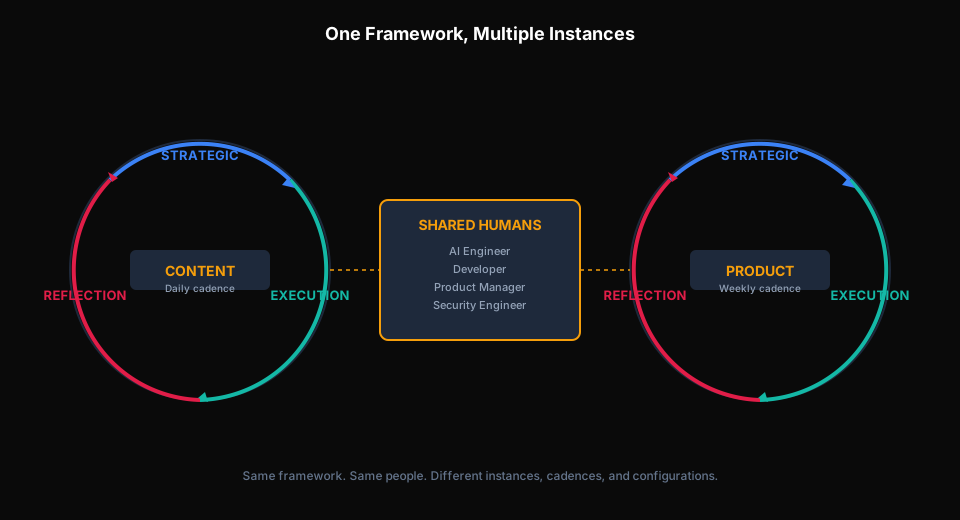
Think of each instance as a fleet. A fleet has its own agents, its own workspace, its own configuration, its own reflection data. The humans who participate in the fleet might also participate in other fleets, wearing different hats, owning different domains. The fleet is the unit of operation. The organization is the collection of fleets.
One distinction worth naming before going further: APEX applies to two different production modes. The first is artifact production — the team builds something that ships and lives indefinitely, like a software feature or a data infrastructure. The second is recurring operations — the team produces fresh deliverables on a repeating cycle, like daily reports or an ongoing editorial pipeline. The framework holds in both cases. The cadence differs, the harness choice differs, the rhythm of Reflection differs. But the underlying loop — Strategic design, agent-driven Execution, data-informed Reflection — is the same. The three walkthroughs below cover both modes: the product fleet is artifact production, the content and research fleets are recurring operations.
Chapter 2: Product Development Team
Let's walk through a complete APEX cycle for a product team building features for a SaaS application. I'll go through each phase with specific artifacts, specific agents, and specific decisions — the kind of detail you'd actually need to set this up.
The People
Seven experts, each owning specific domains:
- CTO / Tech Director — owns Infrastructure. The harness decision, the model strategy, the compute architecture. This is the person who understands runtime tradeoffs and makes the strategic platform calls.
- Tech Lead — owns Orchestration Design and co-owns Agent Design. They know the codebase, they know the patterns, they design how work flows between agents.
- Product Manager — owns Business Context and Spec Engineering. Closest to the market, the users, the business case. Their specs are what agents execute against.
- AI Engineer — owns Agent Design and co-owns Infrastructure. They configure agent identities, skills, memory, and tool access. They understand how agents consume context and where drift happens.
- Developer — owns Operational Tooling. Dashboards, metrics pipelines, context-generation tools. The infrastructure that makes data-driven Reflections possible.
- QA Lead — owns QA Strategic and QA Operational. They define what "done" means and translate those definitions into automated agent-level checks.
- Security Engineer — owns Security & Compliance. Permissions, audit trails, access boundaries.
Notice: every person maps to specific domains. Nobody owns everything. Nobody owns nothing. The domain ownership matrix from Part 1 isn't decorative — it's the operating agreement.
Strategic Phase
This is where the team designs the system that agents will execute within. Every artifact here feeds directly into what happens during Execution.
Infrastructure decisions. The CTO chooses OpenClaw as the orchestration harness — autonomous scheduling, lifecycle management, and specialized agents spawned as sub-agents for their respective domains. Frontend work routes to a frontend agent, integrations to an integration agent, QA to a QA agent. Each agent carries domain-specific context and skills. The model strategy is tiered: Opus for code review (where nuance matters most), Sonnet for code generation (balancing quality and speed), Haiku for quick checks like linting and formatting validation.
Business Context. The PM populates the fleet workspace with three documents: a product vision doc articulating where the product is going, a competitive analysis mapping the landscape, and user personas describing who they're building for. All markdown, all in the fleet workspace where agents can reference them. These documents aren't thrown over a wall — they're the context that every agent reads before producing output. The richer they are, the less agents infer, and inference is where drift happens.
Spec Engineering. For the current cycle, the PM writes a feature PRD: what the feature does, who it's for, acceptance criteria, technical constraints. The acceptance criteria are specific and testable — not "the feature works well" but "API response time under 200ms, error states render the correct component, validation messages match the copy doc." Vague specs produce vague output. This is Principle 3 in action.
QA Strategic. The QA Lead defines the definition of done for this cycle: all tests pass, code review criteria are met (no security vulnerabilities, follows existing architectural patterns, proper error handling), performance benchmarks are hit. These aren't abstract goals — they're the criteria that the review agent will check against in every iteration, and that developers will verify at the end.
Agent Design. The AI Engineer and Tech Lead configure four agents:
- An Architect agent that reads the PRD, understands the system's technical landscape, and decomposes features into implementable tasks. This isn't a generic planner — its identity file contains architectural decision records, system diagrams, and the team's technical standards. It assigns tasks to the right specialist and reviews their output with architectural judgment.
- A Frontend Developer agent with a SOUL.md containing UI component standards, design system references, and accessibility requirements. It has skills for running the dev server, executing component tests, and building the frontend. It understands the design system and knows how to translate specs into polished interfaces.
- An Integrator agent focused on backend connections, API integrations, data flows, and service orchestration. Its identity includes API contracts, auth patterns, and infrastructure documentation. Where the Frontend Developer builds what users see, the Integrator builds what connects everything underneath.
- A QA Engineer agent that writes regression tests and end-to-end tests for completed work. It reads the acceptance criteria from the spec, reviews the implementation, and produces test suites that verify the feature works as intended. It runs after human verification confirms the implementation is correct — codifying that correctness into automated tests.
Orchestration. The Tech Lead designs the flow: Architect decomposes the PRD and assigns tasks to Frontend Developer and Integrator (which can work in parallel on independent tasks). When a task is complete, the Architect reviews the output against architectural standards and QA criteria. If it doesn't meet the bar, it goes back to the implementing agent with specific feedback. If it passes, the task surfaces for human verification. Once the human approves, the QA Engineer agent builds regression and e2e tests for that task. After all tasks in the cycle are verified and tested, the execution loop closes. The routing is explicit. No agent decides on its own where work goes next.
Operational Tooling. The Developer sets up a dashboard showing iteration depth per task, first-pass acceptance rate, and cycle time per feature. These are the metrics that will make the Reflection phase concrete instead of speculative.
Security. The Security Engineer configures access boundaries: the Frontend Developer and Integrator agents can access the staging environment but not production. They cannot access customer data. They can read architectural docs but cannot modify infrastructure configuration. The QA Engineer can run tests against staging but cannot deploy. Least privilege, documented in a Permission Map.
Execution Phase
The system is designed. Now agents run.
The PM writes the feature spec and pushes it into the fleet workspace. The Architect reads it, reads the product architecture docs, and decomposes the feature into five tasks — three frontend tasks and two integration tasks. The Frontend Developer picks up the first UI task while the Integrator starts on the API layer. They work in parallel on independent tasks.
The Frontend Developer completes its first task. The Architect reviews: does it follow the design system? Are components structured correctly? Is accessibility handled? First pass: the Architect flags that the error state component doesn't match the design system's pattern. The Frontend Developer fixes it. Second pass: the Architect approves. The task surfaces for human verification.
A Developer verifies. They're not checking CSS — the Architect already handled structural review. They're checking intent. Does this implementation capture what the PM specified? Does it fit the user flow? Is this the right abstraction? These are the questions only a human with deep product knowledge and daily context in the codebase can answer.
Once the Developer approves, the QA Engineer agent activates. It reads the acceptance criteria from the spec, studies the implementation, and writes regression tests and end-to-end tests that verify the feature works correctly. These tests become part of the codebase — codifying human-verified correctness into automated checks that protect against future regressions.
Meanwhile, the Integrator has finished the API integration task. The Architect reviews: does it follow the auth patterns? Are error states handled? Is the data contract correct? The Integrator adjusts based on feedback, the Architect passes it, a Developer verifies, and the QA Engineer builds integration tests.
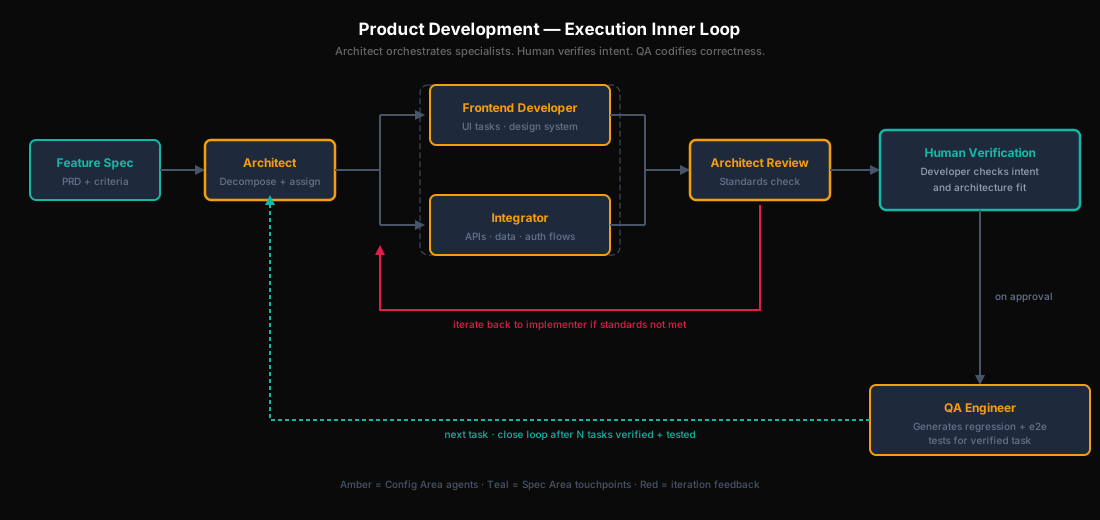
This pattern repeats across all five tasks. Some tasks take one Architect review pass. Some take three. Frontend and Integrator work in parallel where possible, converging when tasks have dependencies. The dashboard updates in real time. By the end of the cycle, five tasks are verified, tested, and merged.
The velocity gain is real. In a traditional workflow, developers review every pull request line by line and QA manually writes test plans. Here, developers review pre-validated output and QA tests are auto-generated from verified implementations. The cycle that used to take a week compresses into two days of agent execution plus verification touchpoints.
Reflection Phase
The cycle is complete. Five features implemented, reviewed, verified, merged. Now the team pauses to learn.
The Developer pulls up the dashboard. The team sees the data:
- Feature A took 4 iterations average. Feature B took only 2.
- First-pass acceptance rate across the cycle: 62%.
- Human touch rate: 8% — a Developer stepped in once to clarify an architectural decision mid-loop.
The agents report their observations. The Integrator agent's logs show that API integration tasks consistently required more review passes from the Architect. The Architect's reports show a pattern: the Integrator kept misinterpreting the auth flow because the Business Context docs didn't include auth architecture patterns.
The team reflects. The PM realizes the Business Context is missing a critical document — auth architecture and integration patterns. Without it, the Integrator infers auth patterns from code samples, and those inferences are often wrong. The AI Engineer notes that the Integrator agent's identity file doesn't reference any auth-specific documentation because none existed. The QA Engineer also flags that its test coverage for auth flows was shallow because it had no reference architecture to test against.
Calibration actions:
- PM adds an auth architecture patterns document to Business Context
- AI Engineer updates the Integrator agent's identity file to reference the new auth doc
- AI Engineer updates the QA Engineer agent's test-generation context with auth flow patterns
- QA Lead adds an auth-pattern-specific check to QA Operational
Next cycle, the Integrator won't struggle with auth integration because the context exists. The QA Engineer will generate more thorough auth tests. Iteration depth on API tasks should drop. First-pass acceptance should improve. That's the hypothesis. The metrics will confirm or deny it.
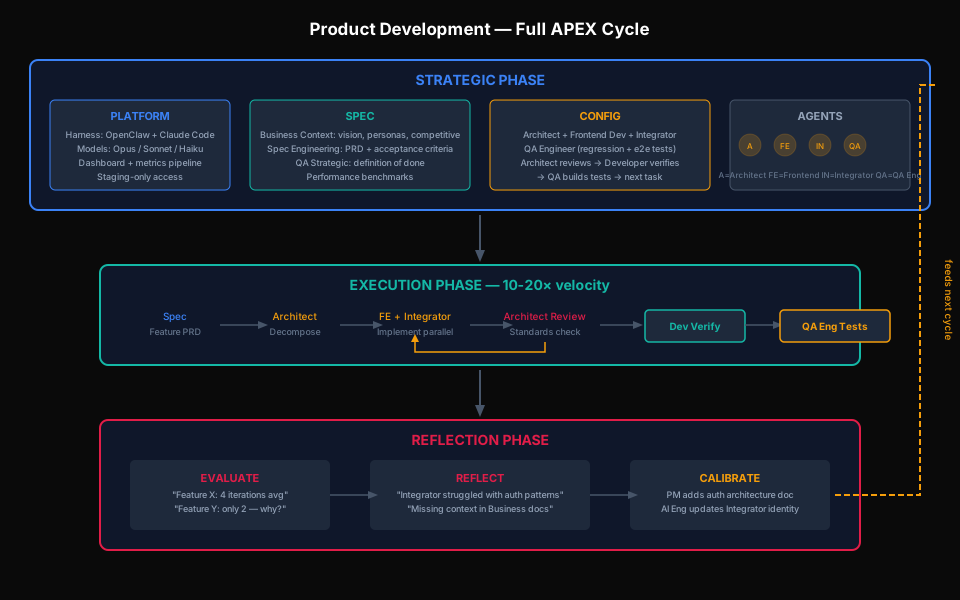
This is what it means for the system to evolve. The agents aren't magically smarter. The context they operate within is smarter, because humans invested in better Strategic design informed by real execution data.
Chapter 3: Content Production Team
Same framework, different world. Let's walk through an APEX cycle for an editorial team producing content at scale.
The People
Six experts:
- Content Manager / Editorial Lead — owns Business Context and QA Strategic. They know the audience, the brand, and what "publish-ready" means.
- Content Strategist — owns Spec Engineering. They write the briefs that drive all content production.
- Copywriter / Editor — contributes to Spec Engineering and QA Operational criteria. Their editorial judgment shapes the quality gates.
- AI Engineer — owns Infrastructure and Agent Design. Same role as in the product team, different configuration entirely.
- Developer — owns Operational Tooling. Editorial dashboards, content metrics, pipeline visibility.
- Brand Manager — contributes to Business Context and Security & Compliance. Protects the brand and defines publishing permissions.
Strategic Phase
Infrastructure. The AI Engineer chooses OpenClaw as an autonomous harness — agents run on a schedule, producing content batches without requiring a human to be present for every execution. The model strategy: Opus for writing (where voice and nuance matter most), Sonnet for review (evaluating against criteria), flash models for research (speed over depth, with source evaluation as a separate quality check).
Business Context. The Content Manager populates the workspace with the documents that define the editorial operation: a brand voice document (tone, vocabulary, personality, what the brand sounds like and what it absolutely doesn't sound like), audience personas (who reads this content and what they care about), an editorial calendar (what's planned and when), and competitive positioning (what differentiates this brand's content from everyone else's). These aren't nice-to-haves. They're the foundation that every content agent references.
Spec Engineering. The Content Strategist creates editorial briefs — one per planned piece of content. Each brief specifies: topic, angle (the specific perspective or argument), tone (where on the spectrum between formal and conversational), word count, SEO keywords, target persona, and references (articles, data, or examples the piece should draw from). A brief is the content equivalent of a feature PRD. Its quality determines the quality of everything downstream.
QA Strategic. The Content Manager defines what "publish-ready" means: fact-checking standards (claims must be sourced), brand voice consistency (measured against the voice document), SEO score threshold, and an originality check. These criteria become the evaluation framework that the review agent uses.
Agent Design. Three agents configured:
- A Research agent that searches the web, evaluates source credibility, and compiles relevant data and quotes. Its identity includes source evaluation criteria — what counts as a credible source, what doesn't.
- A Writer agent with the brand voice document embedded in its SOUL.md. Editorial guidelines are injected into its context. It writes in the brand's voice because it literally carries the brand's voice as part of its identity.
- A Review agent configured to be skeptical. It checks each draft against QA criteria across four dimensions: brand voice consistency, SEO optimization, factual accuracy, and audience relevance. For each dimension it doesn't produce a score — it produces a structured assessment: what's working, what isn't, and specifically why. A flagged brand voice issue comes with the exact phrase that broke register and a suggested alternative. A factual accuracy flag comes with the specific claim and the source that contradicts it. Structured, specific, actionable — because "this feels off" isn't something a Writer agent can act on, but "this paragraph shifts into a tone the brand voice doc explicitly rules out" is.
Orchestration. The flow: Brief → Research agent gathers sources → Writer agent produces a draft → Review agent evaluates and scores → if any dimension is below threshold, Writer revises → Review passes → Editorial Lead verifies.
Operational Tooling. An editorial dashboard showing: articles currently in the pipeline, first-pass acceptance rates by content type, iteration depth per content type, and cycle time from brief to published piece.
Security. Agents can read all brand docs and editorial guidelines. They cannot publish externally without human approval. No content leaves the system without the Editorial Lead's verification. This is a hard boundary — the Brand Manager's requirement.
Execution Phase
The Content Strategist writes a brief for a blog post: "How AI is changing content operations." Topic, angle (practical, not hype), conversational tone, 1500 words, targeting the operations manager persona, with three SEO keywords specified.
The Research agent picks up the brief, searches for recent data on AI adoption in content teams, evaluates sources (industry reports over opinion pieces, recent over outdated), and compiles a source collection with key quotes and statistics.
The Writer agent reads the brief, reads the source collection, reads the brand voice document from its SOUL.md, and produces a first draft. The Review agent evaluates:
- Brand voice: 8/10 — consistent with the voice document, one paragraph drifts into overly formal language
- SEO: 6/10 — primary keyword appears but secondary keywords are underrepresented
- Factual accuracy: 9/10 — all claims sourced, one statistic needs a more recent citation
- Audience relevance: 8/10 — angle is practical as specified
The Review agent flags the three issues. The Writer revises: adjusts the formal paragraph, weaves in secondary keywords naturally, updates the statistic. Second review: all dimensions pass threshold. The article surfaces for human verification.
The Editorial Lead reads the final draft. They're not checking grammar or keyword density — the agents handled that. They're checking: Does this actually serve our audience? Is the angle genuinely practical, or did it drift into generic advice? Would I put the team's name on this? These are editorial judgment calls that no agent scorecard can replace.
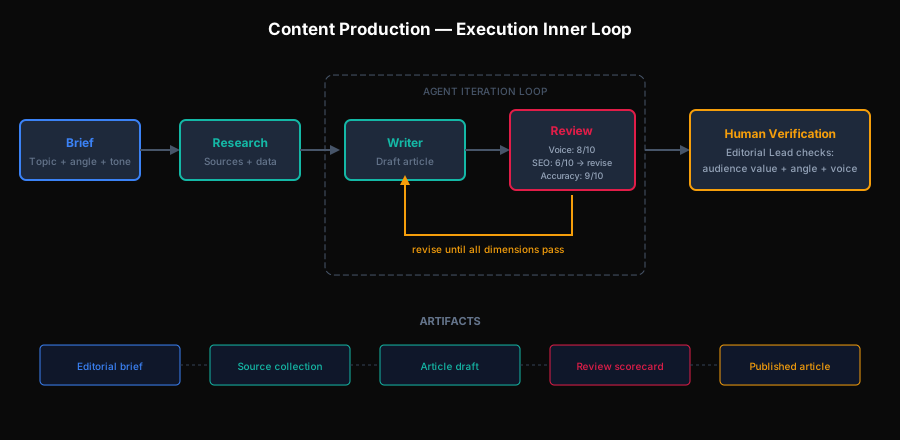
This loop runs across a batch of content. Five briefs go in on Monday morning. By Monday afternoon, three articles have passed the agent loop and are ready for verification. Two are still iterating. By Tuesday, all five are verified and scheduled for publication.
Reflection Phase
The team reviews the weekly data.
The dashboard shows a clear pattern: blog posts hit 75% first-pass acceptance (pass the agent review loop on the first or second try). Social content only hits 40%. LinkedIn posts average 3.2 iterations. Twitter/X posts average 4.1 iterations.
The Review agent's reports reveal the diagnosis: social content briefs don't include platform-specific guidance. The Writer agent uses the same voice and structure for LinkedIn as for Twitter, but they're fundamentally different platforms. LinkedIn tolerates longer, more detailed posts. Twitter demands compression and punch. The briefs treat them identically.
The team reflects. The Content Strategist realizes the editorial briefs need a platform-specific tone appendix — not just "conversational" but "LinkedIn-conversational" vs "Twitter-conversational" with concrete examples of each. The Copywriter/Editor contributes specific criteria: LinkedIn can include data and nuance, Twitter needs a single compelling point with no preamble.
Calibration actions:
- Content Strategist adds platform tone appendix to editorial briefs in Spec Engineering
- AI Engineer creates platform-specific skills for the Writer agent — different writing approaches loaded based on the target platform in the brief
- QA Lead adds platform-specific criteria to QA Operational — the Review agent now evaluates Twitter content against Twitter standards, not generic standards
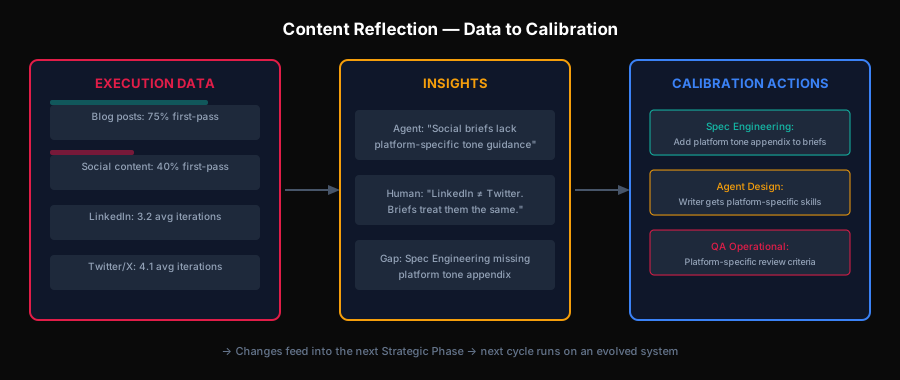
Next cycle, social content acceptance should improve because the specs are sharper and the agents are configured for platform-specific execution. The hypothesis goes into the next Reflection for validation.
Chapter 4: Data & Research Team
This walkthrough changes the harness. Product and content both ran on flexible setups — OpenClaw coordinating autonomous agents, review loops, room to iterate. Fitting choice when the shape of the output isn't fully known until you produce it. A financial research team running a daily market analysis pipeline is a different animal. The shape is known. The steps are fixed. The auditability requirements are non-negotiable. That's a LangGraph problem.
Let me walk through a complete APEX cycle for a research team running daily analysis for a quantitative fund.
The People
Six experts:
- Head of Research — owns Business Context and Spec Engineering. They know what signals matter, what the fund is looking for, and how the daily report needs to read.
- Data Engineer — owns Infrastructure and co-owns Agent Design. The harness decision sits here, along with the pipeline topology.
- Quant Analyst — owns QA Strategic. What counts as a real signal, what's noise, what the false positive threshold is.
- Compliance Officer — owns Security & Compliance. Approved data sources, audit trail requirements, regulatory constraints. This domain carries more weight in a research fleet than it did in either of the previous fleets.
- Developer — owns Operational Tooling. Dashboards for signal quality, coverage, compliance pass rate.
- Risk Manager — contributes to QA Strategic alongside the Quant Analyst.
Strategic Phase
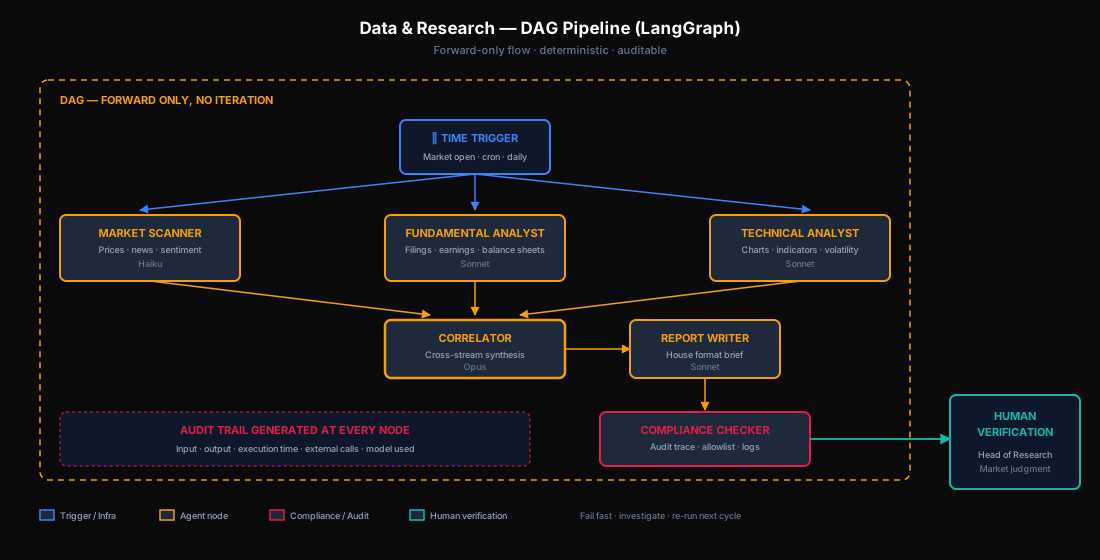
Infrastructure. The Data Engineer picks LangGraph. This is the first real divergence from the previous two fleets, and it's worth dwelling on. LangGraph is a DAG-based harness — you declare the nodes, you declare the edges, the graph runs forward. There are no loops, no agents deciding where work goes next. The topology is fixed at design time.
For product work I wouldn't choose that. Features surface unknowns during implementation, and you want the system to be able to route work back for another pass or bring in a different specialist mid-flow. For content work I wouldn't choose it either — editorial iteration is the whole point of the Review → Writer feedback cycle from Chapter 3. For a daily analysis pipeline, the fixed shape is exactly what you want. Every run does the same thing. Every run produces the same artifact type. Every run needs to be auditable end to end. LangGraph's determinism becomes a feature.
Model strategy: Opus for the Correlator, which has to synthesize across multiple analysis streams and make nuanced judgments about what's actually a signal. Sonnet for the individual analysts doing well-defined analytical work. Haiku for data extraction — pulling structured fields out of filings and news items where speed and cost matter more than reasoning depth.
Business Context. The Head of Research populates the workspace with the fund's research thesis, the market coverage scope, investment universe definitions, and competitive positioning of the fund. These documents define what the system is looking for before any individual daily run begins. Agents that don't know the fund's thesis will flag generic patterns as signals. Agents that know the thesis will flag patterns that matter to this fund specifically.
Spec Engineering. The Head of Research writes the daily analysis spec: what to watch, what triggers alerts, what goes into the daily report, what format the report takes. This is the equivalent of the product fleet's PRD or the content fleet's brief — the concrete instruction each daily run executes against.
QA Strategic. The Quant Analyst, with the Risk Manager contributing, defines the quality criteria. What makes a signal real? What's the false positive threshold the fund is willing to accept? What coverage does the daily report need to hit to be complete? These aren't aesthetic judgments like brand voice or architectural judgments like code review — they're statistical thresholds. The QA Strategic artifact for a research fleet looks like a risk framework, not a style guide.
Agent Design. The Data Engineer and Head of Research configure six agents as DAG nodes:
- Market Scanner — fetches price data, news, and sentiment from the approved source allowlist. Haiku-tier. Structured extraction, not reasoning.
- Fundamental Analyst — reads overnight earnings reports, balance sheets, and financial statements. Sonnet. Domain-specific analytical work.
- Technical Analyst — runs chart patterns, indicators, and volatility analysis. Sonnet.
- Correlator — synthesizes the three upstream analysts' outputs and flags cross-stream patterns. This is the node that benefits most from raw reasoning horsepower. Opus.
- Report Writer — formats the Correlator's output into the house report format. Sonnet.
- Compliance Checker — verifies no forbidden data sources were touched during the run, confirms all external calls are logged, and generates the audit trace. Sonnet with strict instructions.
Orchestration. In the product and content fleets, orchestration was a routing layer sitting above the agents — something the Tech Lead or AI Engineer designed separately. In this fleet, the DAG is the orchestration. Market Scanner, Fundamental Analyst, and Technical Analyst run in parallel, kicked off by a single time-based trigger. All three converge on the Correlator. The Correlator feeds the Report Writer. The Report Writer feeds the Compliance Checker. The Compliance Checker surfaces the result to human review. One directed graph, forward-only edges.
There is no iteration between agents. The Correlator doesn't ask the Fundamental Analyst to re-examine a filing. The Report Writer doesn't send drafts back to the Correlator for revision. If a node produces degraded output, the degradation flows forward and the downstream node either compensates or flags it in its own output. If a node fails outright, the whole run fails and gets investigated as an incident. That's exactly the behavior a compliance-heavy pipeline needs. Retries and recoveries inside the graph would make the audit trail ambiguous.
Operational Tooling. The Developer builds a signal quality dashboard: hit rate of flagged signals (did the flagged patterns actually move?), false positive rate, coverage completeness (did every segment of the investment universe get scanned?), cycle time per run, and compliance pass rate. These are the metrics the Reflection phase will use.
Security & Compliance. Strict allowlist of data sources — if it's not on the list, no agent can call it, and the Compliance Checker fails the run if anything tries. Audit trails are built into every node because that's how DAG harnesses already work: each node's input, output, and execution time is captured by default. The Compliance Officer turns this into a feature by requiring that every run produces a full audit artifact. Agents cannot touch raw customer portfolio data — that's a hard boundary. All external API calls are logged.
Execution Phase
A cron trigger fires at market open. No human initiates the run — the whole point is that the pipeline runs deterministically on schedule.
Three parallel streams kick off immediately. The Market Scanner pulls real-time price data, news headlines, and sentiment scores from the approved sources. The Fundamental Analyst pulls overnight filings — 10-Qs, 10-Ks, earnings releases — and extracts the material claims and numbers. The Technical Analyst runs chart pattern detection, momentum indicators, and volatility analysis across the universe.
The three streams finish at different times, but the DAG waits for all of them before the Correlator activates. When they've all reported in, the Correlator reads the three outputs and looks for cross-stream patterns. A fundamental signal combined with a matching technical pattern combined with a news catalyst is what the fund cares about. Any one of them in isolation is noise. The Correlator produces a ranked list of insights with confidence scores.
The Report Writer takes the ranked list and formats the daily brief in the house style — structured sections, consistent phrasing, specific fields for trading desk consumption. The Compliance Checker reads the full execution trace, verifies that every data access was on the allowlist, confirms that no forbidden sources were touched, and writes an audit log artifact that gets archived alongside the report.
Then the Head of Research reads the brief. Not to check structure — the Compliance Checker already did that. To check whether the signals actually make sense to a human with market judgment. Are the correlations real or spurious? Does the narrative hold? Would you put this in front of the trading desk? These questions are irreducibly human. Once the Head of Research signs off, the report goes out.
The cycle looks nothing like the product cycle or the content cycle. Work moves forward or it stops. That's the correct behavior for this use case. Auditability and determinism beat recoverability when you're producing compliance-sensitive output on a fixed schedule.
Reflection Phase
Reflection on a daily pipeline happens weekly. You can't learn from a single day — you need a week of runs to see patterns.
The Developer pulls up the signal quality dashboard. The week's data: 70% of flagged signals led to actual market moves, 30% were false positives. Coverage completeness hit 98% — two sectors had partial coverage because data source rate limits throttled the Market Scanner during the heaviest part of the run.
The agents report observations through execution logs. The Fundamental Analyst consistently shows lower confidence scores on energy sector filings. When the Head of Research digs into specific runs, the pattern becomes clear: the energy sector uses terminology that isn't in the fund's Business Context documents — unit conventions, midstream vs upstream distinctions, specific hedging language — and the Fundamental Analyst has been inferring meaning from context rather than drawing on explicit reference material. Inference produces lower confidence and weaker signals.
The team reflects. The Head of Research realizes the Business Context needs an energy sector vocabulary guide. The Quant Analyst tightens the false positive threshold specifically for energy signals — until the vocabulary gap is closed, the fund should require stronger confirmation on that sector before flagging anything.
Calibration actions:
- Head of Research adds an energy sector vocabulary guide to Business Context
- Data Engineer updates the Fundamental Analyst's identity file to reference the new vocabulary doc
- Quant Analyst tightens QA Strategic thresholds for energy sector signals
- Developer adds a per-sector confidence breakdown to the dashboard so this pattern is visible in real time going forward
Next week's runs will show whether the calibration worked. That's the loop. It looks different from the product team's loop and different from the content team's loop, but the underlying structure is identical: data-driven Reflection feeding back into Strategic improvements.
Chapter 5: One Organization, Three Instances
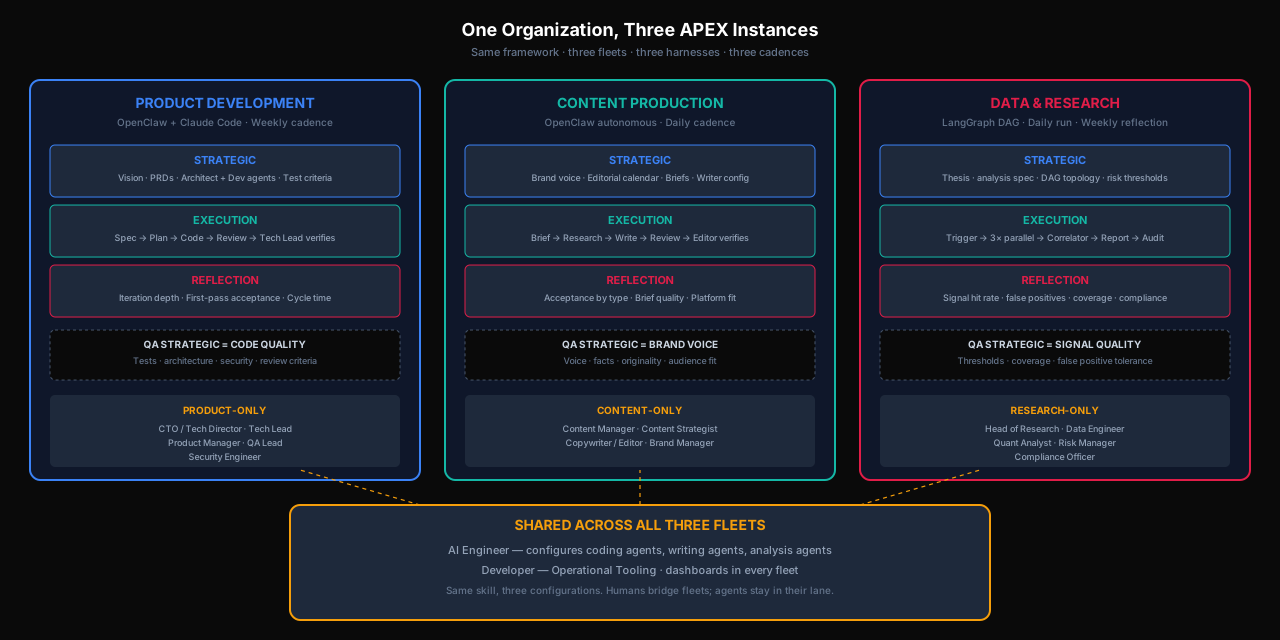
Here's where it gets interesting. All three of these teams exist in the same organization. Some of the same people participate in multiple APEX instances — but with different domain ownership in each.
The AI Engineer owns Infrastructure and Agent Design in the product and content fleets, and co-owns Agent Design alongside the Data Engineer in the research fleet. In the product fleet, they configure coding agents — an Architect, Frontend Developer, Integrator, QA Engineer — loaded with architectural context. In the content fleet, they configure writing agents loaded with brand voice context. In the research fleet, they help configure analysis agents loaded with the fund's thesis and sector knowledge. Same underlying skill — understanding how agents consume context, where drift happens, how identity files should be structured — applied to three completely different agent populations.
The Developer owns Operational Tooling across all three fleets. They might build a shared dashboard platform or separate dashboards per fleet, but the tooling discipline transfers. The metrics being tracked are completely different: iteration depth per feature in product, first-pass acceptance by content type in content, signal hit rate and compliance pass rate in research. Cycle time means three different things in the three fleets. But the muscle of instrumenting, visualizing, and feeding data back into Reflection is the same muscle in every fleet.
QA Strategic is the domain that shifts most dramatically between fleets. In the product fleet, it's code quality — test coverage, architectural conformance, security checks. In the content fleet, it's brand voice, factual accuracy, editorial judgment. In the research fleet, it's statistical — signal thresholds, false positive tolerance, coverage completeness. Three fleets, three completely different definitions of "good." A QA Lead who only understood code quality wouldn't be useful in the content fleet, and neither would know what to do with a research fleet's risk framework. That's why QA Strategic is owned by different people in each fleet — the Tech Lead-adjacent QA Lead in product, the Content Manager in content, the Quant Analyst in research.
The Product Manager owns Business Context in the product fleet and gets consulted on Spec Engineering in the content fleet. The Head of Research owns both Business Context and Spec Engineering in the research fleet but has no role in the other two. The Security Engineer owns Security & Compliance in the product fleet, the Brand Manager contributes to it in the content fleet, and the Compliance Officer owns it outright in the research fleet — where regulatory exposure makes it the heaviest domain of all.
Different Cadences, Different Rhythms
Each fleet runs on its own clock. The product fleet runs weekly cycles — sprint-length iterations with Reflection at the end of each sprint. The content fleet runs daily cycles — briefs in the morning, verified content by end of day, with a weekly Reflection that aggregates the daily metrics. The research fleet runs daily execution and weekly Reflection — every trading day fires a fresh DAG run, but the team only learns from the aggregate pattern across a week of runs.
These cadences are independent. The product team's Reflection doesn't wait for the content team's, which doesn't wait for the research team's. Different work has different rhythms, and forcing them into the same cadence is an anti-pattern. Each fleet calibrates based on its own data, its own metrics, its own patterns.
The numbers mean different things in each fleet. A 70% first-pass acceptance rate on blog posts is excellent. A 70% first-pass acceptance rate on critical infrastructure code might signal a problem in spec quality. A 70% signal hit rate in the research fleet is extraordinary performance for a quantitative fund. Raw metrics don't transfer. The underlying discipline of measuring and calibrating does.
Cross-Fleet Learning
Quarterly, the organization runs a cross-fleet review: what patterns are emerging across fleets? Are there infrastructure improvements that benefit everyone? Has the AI Engineer discovered agent design patterns in one fleet that transfer to the others?
In my experience, the most valuable cross-fleet insights are structural, not content-specific. An AI Engineer who discovers that agents produce better output when identity files reference specific architectural documents in the product fleet will bring that same principle to the content fleet — reference specific brand docs in the writer agent's identity, not just generic instructions. And to the research fleet — reference specific sector vocabulary guides in the Fundamental Analyst's identity, not just generic finance knowledge. The pattern transfers even though the content is completely different.
The cross-fleet review sits above the regular APEX cycle. The regular cycle is fleet-specific — that's what keeps the cadence tight and the calibration relevant. I've seen organizations try to create a "meta-APEX" layer that coordinates across all fleets. That's overhead that doesn't earn its keep. Each fleet runs independently. Cross-pollination happens through people who participate in multiple fleets, and through quarterly reviews that surface transferable patterns. Keep it simple.
Context Architecture
In practice, the organization uses Notion as its master source for documentation. An automated export pipeline generates fleet-specific markdown workspaces. The product fleet workspace contains product vision docs, PRDs, and architecture patterns. The content fleet workspace contains brand voice docs, editorial guidelines, and audience personas. The research fleet workspace contains the fund's research thesis, sector vocabulary guides, and the daily analysis spec. Each workspace is the complete context for that fleet's agents. Clean boundaries, no cross-contamination.
This separation matters more than it might seem. When a content agent has access to product architecture docs, it doesn't use them maliciously — it uses them confusingly. Context pollution leads to drift. An agent that sees engineering specs alongside editorial briefs will sometimes blend the styles, referencing technical details in audience-facing content or adopting a formal spec-writing tone when it should be writing in brand voice. A research agent that accidentally ingested marketing copy would start hedging its signals with promotional language. Fleet-specific workspaces eliminate this class of problem entirely.
The master source stays unified for the humans. The Content Strategist can look up product roadmap context in Notion when writing a brief about an upcoming feature. The PM can reference brand guidelines when writing a feature spec that affects the user interface. The Head of Research can check competitive positioning docs from the marketing workspace when adjusting the fund's thesis. But agents see only their fleet workspace. Humans bridge the fleets. Agents stay in their lane.
Chapter 6: Start Thinking in APEX
APEX scales by instantiation, not by making one instance bigger.
When a new team needs agentic execution — a customer support team, a data analytics team, a marketing operations team — you don't bolt them onto an existing fleet. You instantiate a new one. Same framework, same areas, same domains, same phases. Different people, different agents, different artifacts, different cadence.
Each fleet is lightweight. Add one when you need it. Remove it when you don't. The cost of running a fleet is the investment in its Strategic artifacts and the discipline of running Reflections. That investment pays off because calibration makes the system better every cycle.
The tooling is almost beside the point. I know that sounds counterintuitive in a field obsessed with tools, but the durable advantage isn't in which harness you pick or which model you use. Models improve every quarter. Harnesses evolve. The durable advantage is in the artifacts — the business context docs, the spec engineering templates, the agent identity files, the QA criteria, the orchestration designs — and in the calibration discipline that keeps those artifacts improving.
Organizations that figure out human-agent team structures will have structural advantages that compound over time. I wrote about this compounding effect in The Three Levels of AI Acceleration and mapped the domain expertise needed in Nine Domains of Autonomous AI. APEX is the operating model that connects those ideas into something a team can actually run.
If I were starting from zero today, here's what I'd do:
Pick one team. The one with the clearest work patterns and the most receptive people. Don't try to transform the whole organization at once.
Map the domains. Walk through the nine domains and figure out who owns what. Use the product development and content production examples from this article as templates, not prescriptions. Your team is different. Your mapping will be different.
Run one cycle. Configure the Strategic phase (even partially — it doesn't need to be perfect). Run Execution. Run Reflection. Measure what happens. The first cycle will be messy. That's fine. The point is to start the learning loop.
Calibrate and repeat. Use Reflection data to improve the Strategic configuration. Run another cycle. The second cycle will be better than the first. The fifth will be dramatically better than the second. This is the compounding effect in action.
I think the organizations that treat human-agent team design as a first-class discipline — not an afterthought, not a weekend experiment, but a genuine operational investment — will pull ahead in ways that are hard to reverse. The compounding nature of calibration means that every cycle creates distance between teams that run the full loop and teams that set up agents once and hope for the best.
The tools will keep changing. The models will keep improving. The harness options will multiply. The thing that stays constant is the need for humans to design the system, verify the output, and feed execution data back into better design. That's the APEX cycle. It doesn't depend on any specific tool or model. It depends on the discipline of running all three phases, every cycle, without cutting corners on Reflection.
The complete framework reference is in The APEX Framework. Everything you need to understand the areas, domains, principles, and metrics lives there. This article showed you what it looks like when real teams run it.
Start with one fleet. One cycle. Measure, reflect, calibrate. The system will teach you what it needs next.