On April 4th, Anthropic cut off subscription access for third-party harnesses like OpenClaw. On April 8th, they announced Managed Agents — a hosted service that does what those harnesses do, but inside Anthropic's own platform. On April 4th, Anthropic did three things. They cut subscription access for third-party harnesses like OpenClaw. They launched Claude Code Ultraplan — an agentic planning workflow built into their own CLI. And they set the stage for what came four days later: Managed Agents, a hosted service that does what those third-party harnesses do, but inside Anthropic's platform.
If you've worked in enterprise software, this sequence should feel familiar.
We've Seen This Before
In the early 2000s, open-source e-commerce pioneered the category. osCommerce, Magento, WooCommerce — they proved you could run a full online store on self-hosted software. Ecosystems formed. Agencies grew. Then Shopify arrived with a hosted version: same capabilities, less friction, no server management. Shopify didn't invent e-commerce. It packaged it.
The CMS world ran the same sequence. WordPress, Drupal, and Joomla democratized content management. Then Contentful, Sanity, and Storyblok arrived with polished, headless alternatives. They didn't invent content management. They turned it into a service.
The pattern is consistent:
- Open-source pioneers prove the concept — taking the risk, building communities, validating the market
- Adoption grows, ecosystems form
- A vendor builds a hosted version that's more polished and easier to operate
- The vendor leverages a structural advantage the open-source project can't replicate
- The market consolidates around the hosted option
Anthropic is running step 3, 4, and 5 simultaneously.
What Anthropic Actually Built
I want to be precise, because this isn't about dismissing the technology. Managed Agents is genuinely impressive engineering.
The core architecture separates three concerns: the brain (Claude and its harness loop), the hands (sandboxes and tool execution), and the session (a durable event log). Each is an independent interface. Each can fail, scale, or be replaced without affecting the others.
This solves real problems. Previously, everything lived in one container — if it died, the session was lost. The new design treats containers as cattle: brains start without waiting for sandboxes, sessions survive crashes, credentials never touch the execution environment, and multiple brains can share hands.
The session architecture is particularly interesting. Instead of irreversibly compacting context when the window fills up (and hoping you kept the right tokens), the session log stores everything durably. The harness interrogates it selectively via getEvents(). This is a better approach than what most open-source harnesses currently implement.
Performance improved too — 60% reduction in median time-to-first-token, over 90% at p95. Real numbers from a real system.
Ultraplan complements this by letting you start a complex planning task from the CLI, draft it on the web, and execute it remotely. The terminal stays free while the plan gets built. It's a thoughtful handoff system, fully inside Anthropic's stack.
This is not a weekend project competing with open source. This is a production-grade platform built by a team that deeply understands the problem space.
The Structural Advantage Is the Model Itself
Here's where the SaaS parallel gets sharper.
Shopify had to build its own structural advantage — payments infrastructure, merchant ecosystem, brand trust. That took years. Contentful had to out-engineer WordPress on developer experience. Also years.
Anthropic's structural advantage already exists: they make the model. They control the intelligence that makes the harness work. When they cut subscription access for third-party tools, they didn't just compete with OpenClaw — they turned off the engine.
OpenClaw, OpenCode, PaperClip — these projects proved the concept of the AI agent harness. They built communities, created ecosystems, made agentic workflows accessible to developers. They pioneered. And now the model provider is packaging what they built into a managed service, while simultaneously restricting access to the fuel those tools run on.
The timing wasn't subtle. The message was clear: if you want agentic workflows powered by the best available models, use our tools.
Why This Time Is Different
But there's a crucial difference between this SaaS cycle and every one before it.
Shopify controlled a platform. Contentful controlled an API. Anthropic is trying to control the intelligence itself. And intelligence — unlike a platform or an API — is being commoditized from below.
Today, frontier general intelligence is expensive and centralized. Training Claude costs hundreds of millions. Running it at scale requires Anthropic's infrastructure. That's the gravity that makes Managed Agents compelling: why fight the platform when the platform controls the brain?
But general intelligence isn't the only kind of intelligence that matters for agentic work.
Many agent tasks don't require frontier reasoning. A formatting check doesn't need Opus. A data extraction step doesn't need the model that found zero-days in OpenBSD. A content review against a style guide doesn't need the most expensive tokens available. These tasks need specialized intelligence — smaller models, tuned for specific domains, at a fraction of the cost. A 4B model tuned for a narrow domain can outperform a general frontier model on that domain's tasks, at perhaps 1% of the token cost. And you can run it locally, on your own hardware, with no API dependency.
This creates a tension that Shopify never faced. Anthropic needs you to consume frontier tokens — that's their revenue. They will never genuinely advocate for "use smaller, cheaper, specialized models where you can" because that advice directly cannibalizes their core business. Managed Agents routes everything through Claude. That's not a flaw in the design — it's the design.
Open-source models are getting better every quarter. Specialized fine-tuning is getting cheaper. Local inference is getting faster. The moat around general intelligence is real today, but it erodes with every Gemma, Llama, and Qwen release. Shopify's moat — payments and merchant trust — only gets stronger over time. Anthropic's moat gets weaker.
The Lock-In We Already Saw
This isn't theoretical. We already saw what platform dependency looks like.
On April 4th, thousands of developers lost their agentic workflows because Anthropic changed a pricing policy. One policy change, immediate impact, no recourse. Users running model-agnostic harnesses with alternative authentication or fallback providers continued working without interruption. Users who depended entirely on Anthropic's subscription didn't.
The e-commerce parallel is instructive. Shopify merchants who built their entire business on the platform discovered that changes to fee structures, app store policies, or feature sets affect everyone simultaneously. The merchants who maintained some infrastructure independence were more resilient.
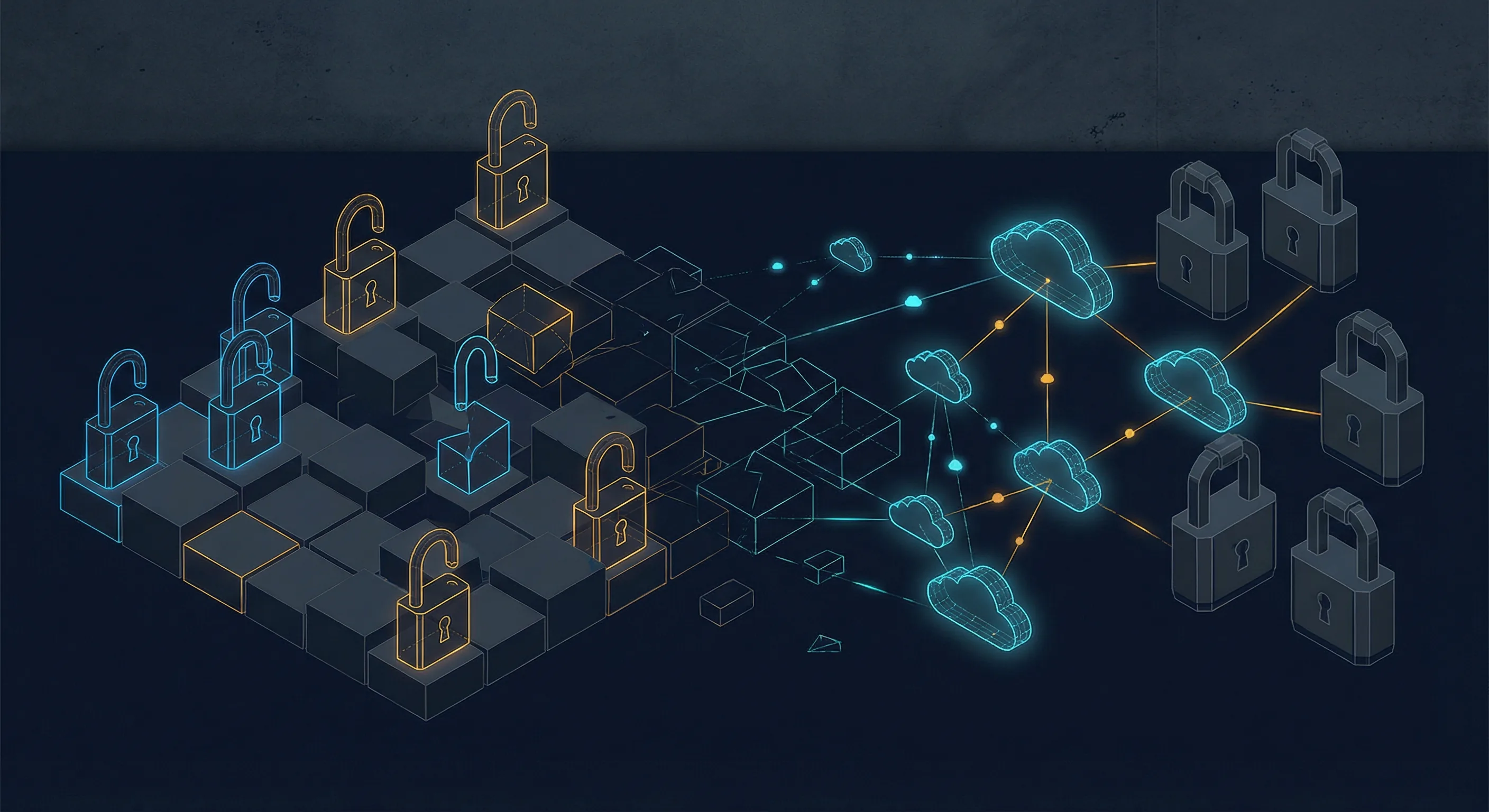
The same dynamic applies to Managed Agents. Every session, every event log, every sandbox execution is mediated by Anthropic. Your agent's memory, execution history, and accumulated context lives in their infrastructure. That's convenient — until the terms change.
The Strategic Question
The choice facing enterprise teams isn't whether Managed Agents is good technology. It is. The brain-hands-session separation is elegant. The security model is well-considered. For teams that want a fully managed agentic platform with the best available models, it's the most complete option today.
The question is what you're optimizing for.
If you're optimizing for time-to-value and you're comfortable with single-provider dependency, Managed Agents is the obvious choice. Ship fast, worry about portability later.
If you're optimizing for long-term resilience, the answer looks different. The organizations best positioned for what's coming aren't the ones that pick a side — all frontier or all specialized. They're the ones that learn when general intelligence is worth the cost and when specialized intelligence is enough. An agentic system that routes an architectural review to Opus, code generation to Sonnet, and a linting check to a local 4B model isn't just cheaper — it's structurally resilient. No single provider's pricing change can take the whole system down.
Model-agnostic harnesses are architecturally suited for this mixed approach. Managed Agents, by design, is not.
In e-commerce, the market eventually evolved toward composable architectures that preserved optionality. In CMS, it evolved toward headless content that decoupled storage from presentation. AI harnesses will most likely follow the same trajectory — from monolithic platforms toward architectures where the orchestration layer is independent of the intelligence layer.
Managed Agents is the Shopify moment for AI harnesses. It's polished, it's powerful, and it will capture a significant share of the market. But the SaaS playbook has a weakness it didn't have before: the fuel that powers these platforms is being commoditized from below, and the open-source alternatives don't need to match Anthropic's models — they just need to be good enough for the task at hand.
The best model wins today. The best architecture wins tomorrow.